Abstract / Brief Description
Funding Scheme: General Research Fund
Funding Amount: HKD 1,059,605
Principal Investigator: Prof. ZAYED Tarek
Project Scope
This research integrates advanced statistical analysis with cutting-edge technologies to develop comprehensive failure prediction systems. The project combines multiple innovative approaches:
1. Advanced Statistical Modeling: Cox regression and survival analysis for failure time prediction
2. Machine Learning Integration: AI algorithms for complex pattern recognition and data analysis
3. Comprehensive Database Development: Multi-source data integration across Hong Kong's network
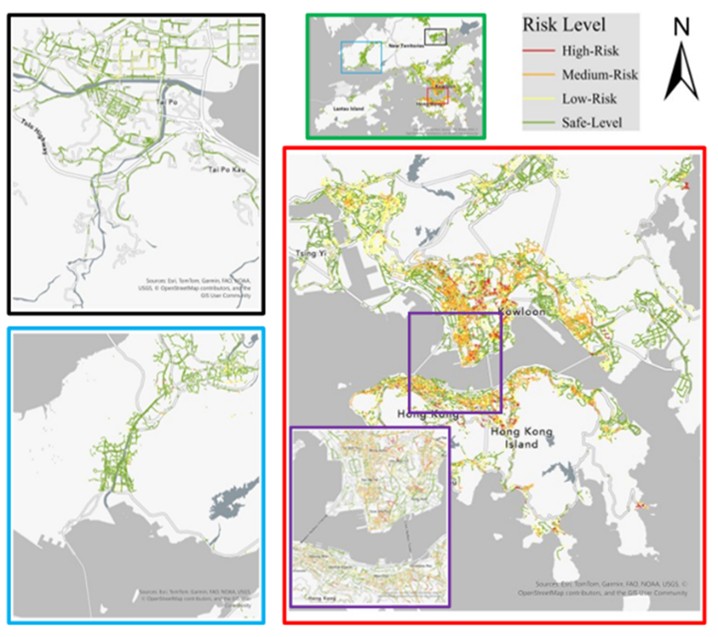
4. Risk Assessment Framework: Evidence-based classification and prioritization systems
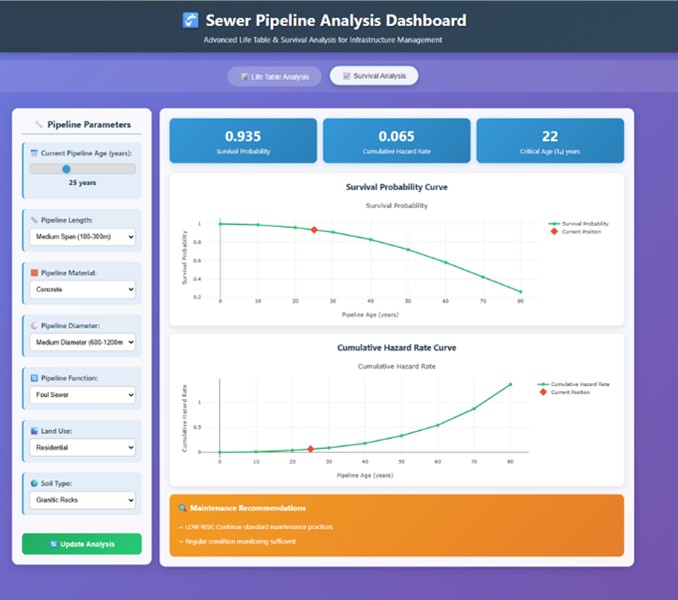
5. Smart Decision Support Tools: User-friendly interfaces for field applications
The project aimed to:
1. Understand and study the critical factors/defects leading to structural and operational failure of sewers including soil characteristics and climate parameters.
2. Within the context of objective 1, develop novel models to predict the timing of failure.
3. Assess the performance of the proposed identification and prediction models, in terms of YES/NO probabilities of failure and false/missed predictions.
4. Calibrate and validate the accuracy of the models proposed, by reference to data on previous sewer failures and through field experiments.
5. Design a GIS-based spatial model illustrating potential areas of failure in the sewerage network (SN).
Key Findings
The project findings/deliverables can be summarised as follows:
1. Critical Risk Factors Identified: Statistical analysis revealed 4 key factors significantly affecting failure probability: diameter × humidity interaction showing 19% risk reduction per standard deviation, district effects with New Territories demonstrating 53% higher risk than Hong Kong Island, industrial areas exhibiting 37% higher failure risk than commercial zones, and pipeline length contributing 25% risk increase per standard deviation increase. These factors were validated through rigorous Cox regression modeling with statistical significance maintained under various conditions.
2. Failure Timing Patterns Discovered: A critical 29-year threshold was identified where failure mechanisms transition from early-phase factors to degradation-based processes. Bimodal failure distributions were observed with concrete pipes showing peaks at 30–40 and 57–60 years, while regional variations revealed distinct patterns: Kowloon demonstrating gradual increase peaking at 55–60 years, New Territories showing concentrated distribution at 30–40 years, and Islands district displaying multiple dispersed peaks across different age ranges.
3. Environmental Impact Quantification: Environmental factor analysis quantified specific deterioration patterns across Hong Kong's diverse conditions. High humidity zones consistently showed poorest performance across all pipe ages, industrial locations began rapid deterioration at the 21-year mark, heavy traffic areas reached warning thresholds at age 44 compared to age 48 for moderate traffic zones, and soil analysis revealed graphitic formations showing earliest warning signs at age 33, enabling location-specific maintenance strategies.